Sunday, 20 October 2013

OUGD501 - CoP Task - Shannon Weaver Model

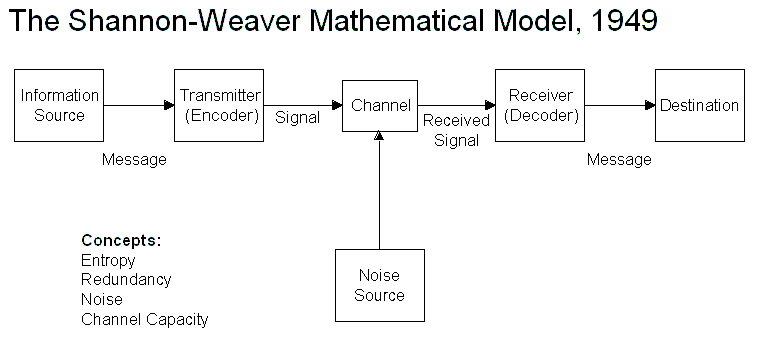
The Shannon-Weaver Model


Apply the Shannon-Weaver model to an example of communication. Consider the following:
  • How widely is this applicable? 
I think that the Shannon Weaver model is widely applicable to most social sciences - but works best for advertising campaigns that need to be tested before published to see if they do their job efficiently.
  • How useful do you find this sort of exercise?
I think that this exercise is useful in that we can see if our design answers the brief but is stinted by the fact that you cannot test something in it's eventual destination before completing the design.
  • What are the main communicative functions of redundancy?
Predictability and understandability are the main functions of redundancy - when the language is short, simple and to the point there is no confusion, no misunderstanding and is perfect for getting the message across. Straight talking.
  • What do we mean by saying the english language is 50% redundant?
The English language boasts 50% more words than it actually needs to be understood. The message can be delivered in much fewer words and so graphic design can utilise this to help get the message across quicker in the short attention time span of the audience.

I have chosen to use these images from a campaign to promote saving tigers from extinction.


Putting the images through the Shannon Weaver Model

The information source - The information is provided by the problem that tigers are nearly being pushed to extinction and that everyone needs to help - so all audiences need to be reached.

Transmitter - Thought provoking image chosen - from a distance it makes the audience question the image, as it is unusual and quirky, but on closer study there is a serious message. I think that it's the idea that dogs and goats are in their millions in comparison to the tiger.

Channel - Poster format chosen as it best showcases the image with plenty of white space to focus on the image.

Receiver - People using public transport are most likely to see it because it is a poster, and so will be displayed in bus stops and on the subways, for example. I found the poster on the internet, and I think that these are the best sources for reaching a wide, general public audience.

Destination - The response to the poster will be a quick website visit - which is really good for being quick and easy and so well received by the general public.

  • Discuss the ways in which convention can be said to facilitate understanding. Think of visual communication that breaks or extends specific conventions. How does this affect the desire to communicate or the audience they reach?
Convention can facilitate understanding in that the thought being provoked by everyday knowledge can bridge the gap to the message being given in the image. This can be stunted when what was thought was common knowledge actually isn't and the reaction provoked was not was the designer was expecting at all.
In the case of the endangered tiger campaign, I  think that the dog image is not a good idea for a quick reaction poster because lots of people love their dogs as a beloved pet and wouldn't consider them replaceable- I don't think it would be received well as a concept! A hamster or a fish, maybe?! They are relying on the fact that there are millions of dogs in the world, but to the audience they can consider their current pet irreplaceable and that would shut their attention span to the campaign.

Tuesday, 8 October 2013

OUGD504 - Design for Print Research

Design for Print further research into designs

Looking for actual idea needs a bit more research into actual designs rather than just materials and facilities to include. This blog posts documents my train of thought through my research.

Here are some of my ideas that have been shaping my further research and vice versa.

Louis Vuitton inspiration

After researching online into different print methods and how they've been used in industry, I came across this design for Louis Vuitton:


It was made for a launch party in China and so origami was used for the invitation. The user had instructions and had to fold it themselves in order to read the invitation and see the logo.
I really love this element of interactivity for the user as it makes it a bit more fun - I'm aiming it at designers as an advert for alternatives to jumping straight on the computer and designing a website to encapture customers.

Posh Pass the Parcel

From this I came up with the idea of a Posh Pass the Parcel that the user would enravel layer by layer to reveal something in the middle. Each layer would feature a different print method and instructions on how to achieve it. 
After the self initiated crit I want to include things that don't rip - traditional pass the parcel is layers and layers of newspaper or wrapping paper that are torn off. Because I want this to be a keepsake ('posh') I need it to be sustainable. 

And so I looked at interesting ways to open packaging that can be reassembled and reaffixed:


This box fixes itself together and can be opened and closed without damage to itself.


I really love the laser cut element that reveals the different textures underneath this design.


Its even better that all these designs feature cool openings that will keep the user entertained and keep the design fun and interactive. 

Cool Nets

After researching into different boxes and openings, I started to look at actual nets that I could use. 
I took out a packaging book with a CD and started to print off some nets to experiment with. 
I don't have the intention of fully copying the nets but for the purpose of research I'm printing them straight off.

Here are the nets I chose:


The assembled nets etc can be found here.


The infinity fold


For my Posh Pass the Parcel design, I wanted to have something in the middle that still expresses print design but the concept of unravelling. This simple design carries that concept perfectly in my opinion and isn't too complicated to achieve.


Wednesday, 8 May 2013

OUGD401 - CoP Module Evaluation

Context of Practice - From Theory into Practice & Essay Evaluation


1. What skills have you learnt throughout this project and how effectively do you think you have applied them?

During this project I have learnt all about the context of where our art comes from. This has helped me to put into perspective the vibes that designs can give out, dependant on their inspiration or place in history. I have applied these same type of lecture-depth understanding to something I love and used it to create my publication.

2. What approaches to/methods of design production have you developed and how have they informed your design development process?

For my publication, I thought about the design production first, as my strength and passion is in pop up books and paper engineering. I chose to fit my subject, my other passion, to this paper concept - Disneyland. Because Disneyland is aimed at younger audiences/ is 'fun' this made the pop up book undoubtedly the best route to go. However due to lack of time management, and probably lack of confidence in my idea, this had to be reworked. I regrettably eventually went for a rather weakly designed version of a 'carousel' book. I resorted to this because the link to the carousel would link into Walt Disney's ride at the park - 'the carousel of progress' - it would make perfect sense. But I think my execution of it was rather poor and disappointing.

3. What strengths can you identify in your work and how have/will you capitalise on these?

I have discovered that I can work fast and efficiently under pressure, and that my academic writing skills are not as bad as I thought! I don't particularly want to capitalise on working under pressure, but will definitely work fast and more efficiently from the beginning of the project.

4. What weaknesses can you identify in your work and how will you address these for the future?

Weaknesses I have identified is that I am not being disciplined enough to keep up to date on daily blog posts. I am also very very poor at time management and in this instance I failed to ask if I was unsure and fell behind with progress because of lack of confidence in the idea. In the future, I will definitely ask for help and work through my idea rather than soldiering on with something that I have limited.

5. Identify 5 things you will do differently next time and what you expect to gain from doing these:


  • Blog everything as I go so it doesn't mount up!!!!!!!!!!!!!!!!!!
  • Leave room for things to go wrong 
  • Come to terms with a failing idea quickly and efficiently and put in place steps to make it work or move on from it.
  • Not be afraid to ask for help - if fellow students are also stumped, ask another informed individual - any advice is good advice when you're really stuck.
  • Experiment more with different materials and mediums to add diversity to my designs

6. How well do you think you've done/5?

Attendance   
4.99

Punctuality   
4.9

Motivation    
3

Commitment 
3

Quantity of work produced
5

Quality of work produced
3

Contribution to the group
5

Tuesday, 7 May 2013

OUGD401 - 'A Brief History of...' Brief and Research based on ideas.

'From Theory Into Practice'

Design, develop and produce a publication entitled; ' A Brief History of...' (completed with a subject of your choice).
A publication can be anything you can read and extract information on. This includes blogs, websites, motion graphics, books, & magazines etc.


  • Think about your audience!
  • Be creative with your format!
  • Think outside the box!
The content of your publication could be based on something from what was studied in the 1st semester, but basically just has to show a deep understanding of a contextual subject or movement and it's impact on the audience and society of the time.

Evidence a deep knowledge of the...


  • Historical & chronological information
  • Social and cultural attitudes
  • Technological advances
  • Political attitudes

...of the time.


Be visual and experimental! Fulfil your choice of content and have fun with it.

Module deadline/ studio deadline: 7th May 2013.


-------

Creative publication inspiration


Ideas and development for this publication can be found here.


Disneyland History book; visual inspiration:

Disneyland Anaheim attractions when they were built:


Jungle cruise, 1955


Space mountain, 1975


Pirates of the Caribbean, 1967


Sleeping Beauty's castle, 1955


Bird animatronics from 'America Sings', 1974


Dumbo the flying elephant, 1955


Monsanto's House of the Future, 1957


Matterhorn, 1959


Mad Hatters tea cups, 1955

Looking into typical 1950's Disney-style illustration:


Screenshots from 'the Disneyland story'


Good typography could inspire different pages in the book?


I need a lot of reference photos of Walt for his illustration.


A good reference photo for the Disneyland story show illustration


The Jungle cruise - with photoshopped erased boat ready for an illustration.

The Frontierland lagoon around the time of Disneyland opening - ready for a paddle steamer illustration.


A picture of Main Street USA in Disneyland a week before opening. I wanted an image without any people on it, so I could add my own. I had to digitally remove Walt from the photograph and another man painting the tram tracks in the road, ready for my illustrated crowd. I also removed the sky and castle for my own illustration.


before and after sepia effect - a photograph I didn't use but was meant for the last page of the book. I wanted the photographs to all look similar and so some were made to look like they were from the 50's as opposed to the 60s-00s


I used the image on the left, and edited to make it black and white even though its from the early 00s. I used the left one rather than the right one, actually from the 50s because the perspective was better for my illustration.


Reference photo used for the illustration of the paddle steamer 

Another good reference photo - the image I would use in the background of the tv for the Disneyland story show.


a picture of a deserted and closed Coney Island.